1. Introduction
Digital marketing has become an important part of how modern businesses connect with potential customers. Instead of relying only on traditional methods such as newspapers, radio, television, or physical advertising, businesses can now use digital channels to reach people online.
These channels can include:
- Search engines
- Websites
- Social media
- Online advertising
- Content and blogs
- Mobile platforms
The main advantage is that businesses can communicate with audiences where they already spend much of their time: online.
2. What Is Digital Marketing?
Definition
Digital marketing is the use of online channels, digital platforms, and technology to promote a business, product, or service and connect with a target audience.
It involves using the internet and digital tools to achieve marketing goals such as:
- Increasing brand awareness
- Attracting website visitors
- Generating leads
- Building customer relationships
- Increasing sales
- Retaining existing customers
Digital marketing is not just about posting on social media.
A complete digital marketing strategy can involve multiple channels working together.
For example:
Google Search → Website → Contact Form → Email Follow-Up → Customer
This is an example of a digital customer journey.
3. How Does Digital Marketing Work?
Digital marketing generally follows a process.
Step 1: Identify Your Target Audience
A business first needs to understand:
- Who are the ideal customers?
- What problems do they have?
- What are they searching for?
- Which platforms do they use?
- What motivates them to make a purchase?
For example:
A website development agency may target:
- Small business owners
- Startup founders
- E-commerce businesses
- Companies needing a website redesign
Understanding the audience helps the business create more relevant marketing.
Step 2: Create Valuable Content or Offers
Once the audience is understood, the business creates something useful to attract attention.
This could include:
- Blog posts
- Videos
- Social media posts
- Guides
- Free consultations
- Product demonstrations
- Case studies
For your agency website, an example could be:
10 Signs Your Business Needs a New Website
This type of content can attract business owners who may eventually need your website development service.
Step 3: Attract the Right Audience
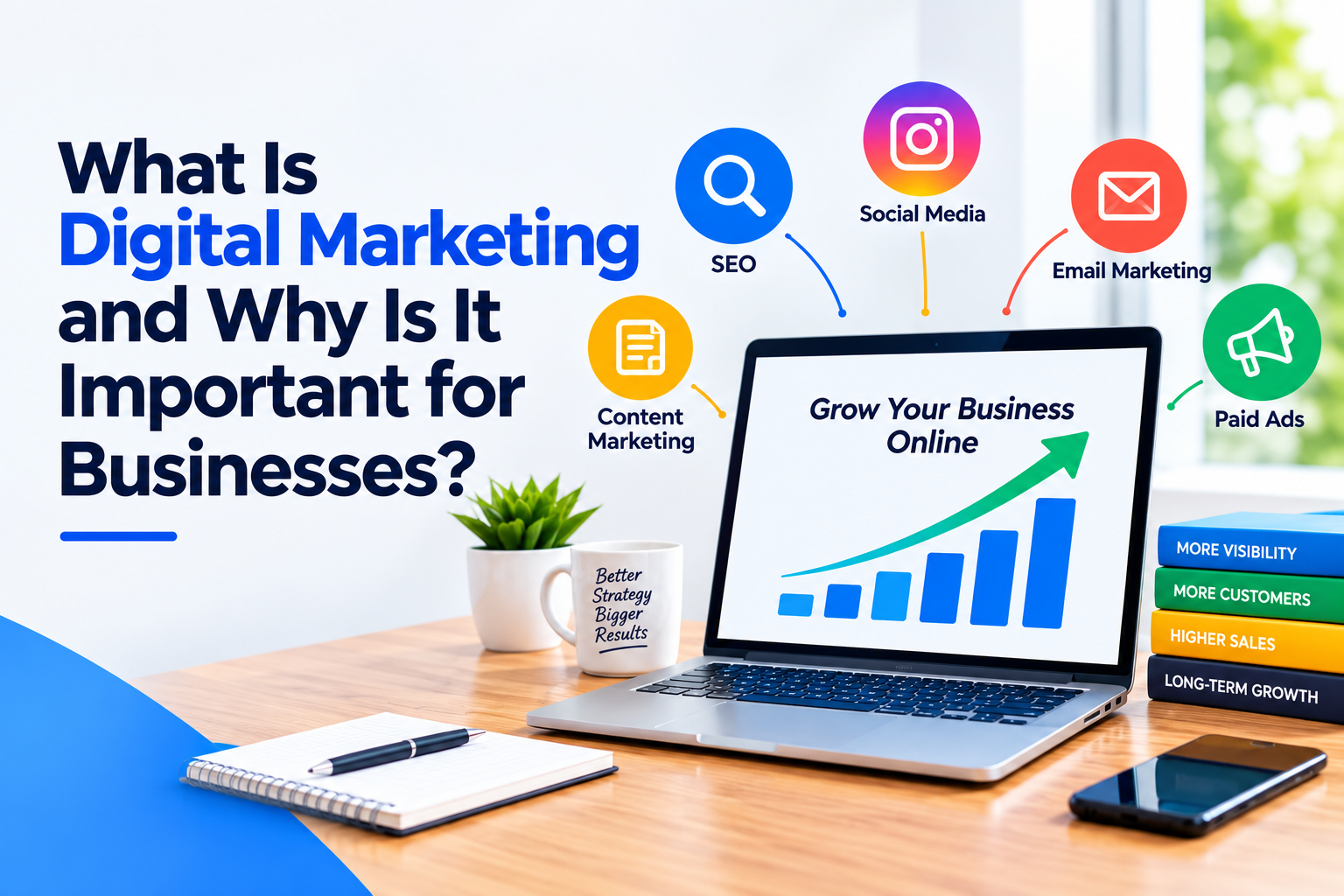
Businesses can attract people through channels such as:
SEO
Helping content appear in search results.
Social Media
Connecting with audiences through platforms and communities.
Paid Advertising
Paying to reach targeted audiences.
Content Marketing
Creating useful content that attracts potential customers.
Email Marketing
Communicating directly with interested subscribers.
Step 4: Convert Visitors Into Leads
Getting traffic is not enough.
Your website should encourage visitors to take action.
Examples include:
- Request a quote
- Book a consultation
- Contact us
- Download a guide
- Subscribe to a newsletter
- Start a project
This is where a good website design and user experience become important.
4. Major Types of Digital Marketing
A. Search Engine Optimization (SEO)
SEO focuses on improving a website’s visibility in search engines.
For example, someone might search:
Website development company in Nigeria
If your website provides relevant and useful information about this service and is technically accessible to search engines, it may become eligible to appear for relevant searches. Google emphasizes useful, unique, well-organized content and does not guarantee a specific ranking position.
SEO can include:
- Keyword research
- Content creation
- On-page optimization
- Technical improvements
- Internal linking
- Improving site structure
B. Content Marketing
Content marketing involves creating useful content to attract and educate an audience.
Examples:
- Blog posts
- Videos
- Case studies
- Guides
- Tutorials
- Infographics
For your website, your blog itself is part of your content marketing strategy.
C. Social Media Marketing
Social media marketing helps businesses:
- Build awareness
- Engage audiences
- Share content
- Build communities
- Generate traffic
However, businesses should choose platforms based on where their target audience actually spends time rather than trying to be everywhere.
D. Email Marketing
Email marketing allows businesses to communicate directly with people who have chosen to receive communications.
Businesses can use email for:
- Newsletters
- Promotions
- Educational content
- Product updates
- Follow-up messages
E. Paid Advertising
Paid advertising allows businesses to reach specific audiences faster.
Examples include advertising through:
- Search advertising
- Social media advertising
- Display advertising
Paid campaigns usually work best when there is a clear goal, targeted audience, relevant offer, and effective landing page.
5. Why Is Digital Marketing Important for Businesses?
This is one of the most important sections of the article.
1. Your Customers Are Online
Many customers search online before choosing:
- A service provider
- A product
- A restaurant
- A technology company
- A freelancer
- A local business
If your business has little or no online presence, potential customers may have difficulty finding and evaluating you.
2. It Can Increase Brand Awareness
Digital channels allow businesses to introduce their brand to more relevant audiences.
For example:
A potential client may:
- See your social media post.
- Visit your website.
- Read your blog.
- Explore your portfolio.
- Contact your business later.
Not every customer converts immediately, which is why consistent visibility can be valuable.
3. It Helps You Reach Targeted Audiences
Traditional advertising can sometimes reach many people who are not interested.
Digital marketing can allow businesses to focus content and campaigns around specific audiences and their needs.
For example:
Instead of writing only:
Our company builds websites.
You could create content such as:
How a Professional Website Can Help Small Businesses Get More Leads
This targets a specific problem and audience.
4. Digital Marketing Can Generate Leads
A lead is someone who has shown interest in your business.
Examples:
- Filling out a contact form
- Requesting a quote
- Booking a consultation
- Subscribing to your newsletter
Your website should make the next step clear.
5. Results Can Be Measured
One advantage of digital channels is the ability to measure performance.
Businesses can monitor things such as:
- Website visitors
- Search impressions
- Clicks
- Traffic sources
- Conversions
- Leads
Google Search Console, for example, provides information about how a site performs in Google Search.
6. Benefits of Digital Marketing
Increased Online Visibility
Helps more potential customers discover your business.
Better Audience Targeting
Allows businesses to create content and campaigns for specific audiences.
Measurable Results
Performance can be monitored and improved.
Improved Customer Relationships
Businesses can communicate and engage with audiences online.
Supports Business Growth
Digital channels can support lead generation and customer acquisition.
Works With Other Business Strategies
Digital marketing can support sales, customer service, branding, and product growth.
7. Digital Marketing and Your Website
Your website should be one of the central parts of your digital presence.
Think of it like this:
Social Media
⬇
Google Search
⬇
Paid Advertising
⬇
Your Website
⬇
Contact / Quote / Purchase / Consultation
Your website is where potential customers can learn about:
- Your business
- Your services
- Your experience
- Your portfolio
- Your testimonials
- Your contact information
This is why website development and digital marketing work closely together.
8. Digital Marketing Channels Working Together
The best approach is often not to rely on only one channel.
For example:
Blog Post
⬇
SEO Traffic
⬇
Website Visitor
⬇
Service Page
⬇
Contact Form
⬇
New Lead
Or:
Social Media Post
⬇
Blog Article
⬇
Website
⬇
Free Consultation
⬇
Potential Client
This demonstrates how different digital marketing activities can support one another.
9. Common Digital Marketing Mistakes
Mistake 1: Trying to Be Everywhere
Businesses do not always need to use every platform.
Focus on platforms where your target audience is active.
Mistake 2: Creating Content Without Understanding the Audience
Always ask:
Who is this content for?
Your content should solve a problem or answer a genuine question.
Mistake 3: Ignoring the Website
Marketing campaigns may generate visitors, but a poor website can make it difficult for visitors to take the next step.
Your website should be:
- Mobile-friendly
- Easy to navigate
- Clear
- Fast
- Professional
- Focused on user needs
Google also emphasizes an overall good page experience alongside helpful content.
Mistake 4: Publishing Content Only for Search Engines
Avoid creating content just because you hope it will attract traffic.
Google’s guidance emphasizes creating content primarily to help people and warns against mass-producing content simply to manipulate search rankings.
Mistake 5: Not Measuring Results
Review your performance regularly.
Ask:
- Which content gets visitors?
- Which pages generate leads?
- What questions are people searching for?
- Which pages need improvement?
10. How to Create a Basic Digital Marketing Strategy
Step 1
Define your business goal.
Example:
Generate more website development leads.
Step 2
Identify your target audience.
Example:
Small businesses and startups.
Step 3
Choose your channels.
Example:
- SEO
- Blog content
- Social media
Step 4
Create useful content.
Example:
How Much Does a Professional Website Cost?
Step 5
Send visitors to relevant pages.
Example:
Blog → Website Development Service
Step 6
Measure results.
Review traffic, engagement, leads, and conversions.
11. Digital Marketing for Small Businesses
Small businesses do not necessarily need a large marketing budget to begin.
They can start by building a strong foundation:
✔ Professional Website
✔ Google Search Visibility
✔ Useful Blog Content
✔ Relevant Social Media Presence
✔ Clear Business Information
✔ Strong Calls-to-Action
The key is consistency and relevance.
12. The Future of Digital Marketing
Digital marketing continues to change as technology and user behavior evolve.
Important areas businesses should pay attention to include:
- Search behavior changes
- AI-powered search experiences
- Content quality
- User experience
- Video and visual content
- Data and measurement
- Personalization
- Trust and transparency
Google’s Search documentation and recent Search Central updates show that search continues to evolve, including changes related to AI experiences and performance reporting.
Frequently Asked Questions
What is digital marketing in simple words?
Digital marketing is the use of online channels and technology to promote a business and connect with potential customers.
What are the main types of digital marketing?
Common types include:
- SEO
- Content marketing
- Social media marketing
- Email marketing
- Paid advertising
Why is digital marketing important?
It helps businesses improve their online visibility, reach relevant audiences, generate leads, and measure marketing performance.
Is digital marketing suitable for small businesses?
Yes. Small businesses can use digital marketing strategies that match their goals, audience, resources, and budget.
Do I need a website for digital marketing?
Not every digital activity requires a website, but a professional website can provide a central place for customers to learn about your business and take action.
Conclusion
Digital marketing gives businesses multiple ways to connect with audiences online. From search engines and websites to social media, content, and email, each channel can play a different role in attracting, educating, and converting potential customers.
The most effective approach is not simply to use every available platform. Instead, businesses should understand their audience, choose relevant channels, create genuinely useful content, and measure what works.
Ready to Grow Your Business Online?
Our team helps businesses build strong digital foundations through modern websites, technology solutions, and effective digital strategies.